
The following sections describe how to configure and discover devices for monitoring in Skylar One using the "Dell: PowerStore" PowerPack:
Prerequisites for Monitoring Dell PowerStore Devices
Before you can discover PowerStore storage devices in Skylar One system, you must have the following:
- Skylar One version 12.3.7 or later.
- The sample universal credential that is already provided with this PowerPack.
- All-In-One Appliance or a distributed system that contains a Database Server.
Configuring Dell PowerStore Credentials
To use the Dynamic Applications in the "Dell: PowerStore" PowerPack, you must first define a PowerStore credential in Skylar One. These credentials allows Skylar One to communicate with PowerStore appliances. The "Dell: PowerStore" PowerPack includes a sample universal credential template you can edit for use to allow Skylar One to communicate with PowerStore devices.
To configure a universal credential using the template:
- Go to the Credentials page (Manage > Credentials).
- Click the button and then select Create Dell PowerStore Credential. The Create Credential page appears.
- Supply values in the following fields:
- Name. Enter a name of credential. Can be any combination of alphanumeric characters, up to 64 characters.
- All Organizations. Toggle on (blue) to align the credential to all organizations, or toggle off (gray) and then select one or more specific organizations from the What organization manages this service? drop-down field to align the credential with those specific organizations.
- Timeout (ms). Keep the default value of 1500 milliseconds. This field defines the time, in milliseconds, after which Skylar One will stop trying to communicate with the external device or application.
- Authentication type. Select Basic Authentication. This field defines the authentication method.
- URL. Enter the URL for your Dell PowerStore cluster using the format: http://your-dell-powerstore-cluster/api/rest.
- Username. Enter the username to access your Dell PowerStore cluster.
- Password. Enter the password to access your Dell PowerStore cluster.
- Click .
Discovering a PowerStore Appliance
To create and run a discovery session that will discover a Dell PowerStore appliance:
- Go to the Devices page (
 ) or the Discovery Session page (Devices > Discovery Sessions) and click the button. The Select page appears.
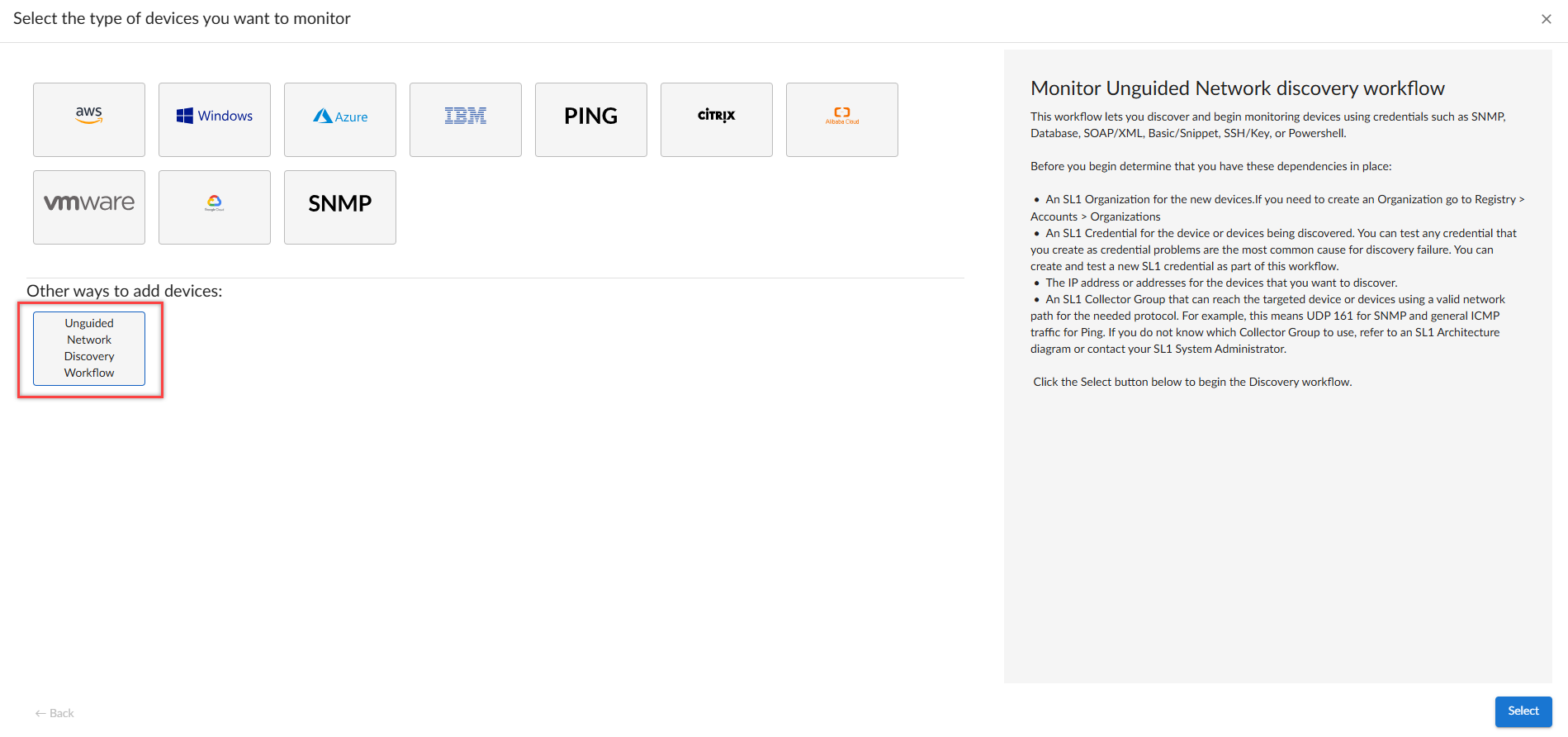
 - Click the button. Additional information about the requirements for discovery appears in the General Information pane to the right.
- Click . The Add Devices page appears.
- Complete the following fields:
- Discovery Session Name. Type a unique name for this discovery session. This name is displayed in the list of discovery sessions on the tab.
- Description. Optional. Type a short description of the discovery session. You can use the test in this description to search for the discovery session on the tab.
- Select the organization to add discovered devices to. Select the name of the organization to which you want to add the discovered devices.
- Click . The Credentials page of the Add Devices wizard appears.
- On the Credentials page, locate and select the credential you created for PowerStore appliances.
- Click . The Discovery Session page of the Add Devices wizard appears.
- Complete the following fields:
- Name. Enter a name for your discovery session.
- List of IP/Hostnames. Type the IP address of your PowerStore cluster.
- Other Credentials. Select the credential you created for PowerStore appliances.
- Run after save. Select this option to run this discovery session as soon as you save the session.
- Advanced options. Click the down arrow (
 ) to complete the following fields:
- Discover Non-SNMP. Enable this setting.
- Log All. Enable this setting.
- If you enabled the Run after save option, click the button. The discovery session will run and the Discovery Logs page will display any relevant log messages. If the discovery session locates and adds any devices, the Discovery Logs page will include a link to the Device Investigator page for the discovered device.
- If you did not enable the Run after save option, click the button. The Discovery Session page (Devices > Discovery Sessions) will display the new discovery session.
Discovering a PowerStore Appliance in the Skylar One Classic User Interface
To create and run a discovery session that will discover a PowerStore appliance, perform the following steps:
- Go to the Discovery Control Panel page (System > Manage > Classic Discovery or System > Manage > Discovery in the classic user interface).
- Click the button to create a new discovery session. The Discovery Session Editor window appears:
- Enter values in the following fields:
- Name. Enter a name for your discovery session.
- IP Address/Hostname Discovery List. Enter the IP address of your PowerStore cluster.
- Other Credentials. Select the credential you created for PowerStore appliances.
- Discover Non-SNMP. Select this checkbox.
- Log All. Select this checkbox.
- You can enter values in the other fields on this page, but are not required to and can simply accept the default values. For more information about the other fields on this page,
- Click the button and then close the Discovery Session Editor window.
- The discovery session you created will appear at the top of the Discovery Control Panel page. Click its lightning-bolt icon (
 ) to run the discovery session.
 - The Discovery Session window will be displayed.
- When the PowerStore appliance is discovered, click its device icon (
 ) to view the Device Properties page for the PowerStore cluster.
Verifying Discovery and Dynamic Applications
To verify that Skylar One has automatically aligned the correct Dynamic Applications during discovery:
- From the Device Properties page for the PowerStore appliance, click the tab. The Dynamic Application Collections page appears.
- The following Dynamic Applications should be displayed in the list of Dynamic Applications aligned to the PowerStore appliance:
- "Dell PowerStore: Storage Container Discovery"
- Dell PowerStore: Appliance Discovery"
- If one or more of these Dynamic Applications are not automatically aligned with each PowerStore device, follow the instructions in the section on Manually Aligning the Dynamic Applications or discover using the device template.
Manually Aligning the Dynamic Applications
If the Dynamic Applications have not been automatically aligned, you can align them manually:
- From the Device Properties page for the PowerStore appliance, click the tab. The Dynamic Application Collections page appears.
- Click the button and then click Add Dynamic Application. The Dynamic Application Alignment page appears.
- In the Dynamic Applications field, select the Dynamic Application you want to align.
- In the Credentials field, select the credential you created for this PowerStore appliance.
- Click .
- Repeat steps 2-5 for the remaining Dynamic Applications.
- After aligning the Dynamic Applications, click the button and then click the plus icon (+) for the Dynamic Application. If collection for the Dynamic Application was successful, the graph icons (
 ) for the Dynamic Application are enabled.
 - Click a graph icon () to view the collected data. The Configuration Report page will display the number of components of each type and the total number of components managed by the PowerStore appliance.