The Preview Features page ( > Account Settings > Preview Features) in Skylar Advisor lets users toggle on and experiment with new features. These features are stable, but ScienceLogic is actively developing and improving them in dialogue with users.
The Preview Features Page
The Preview Features page ( > Account Settings > Preview Features) gives users the option to toggle on one or more new features that will be coming to a future release of Skylar Advisor. Please note that these features are stable, and ScienceLogic is actively developing and improving them in dialogue with users.
These toggles apply only to the current instance, not the entire Skylar Advisor account.
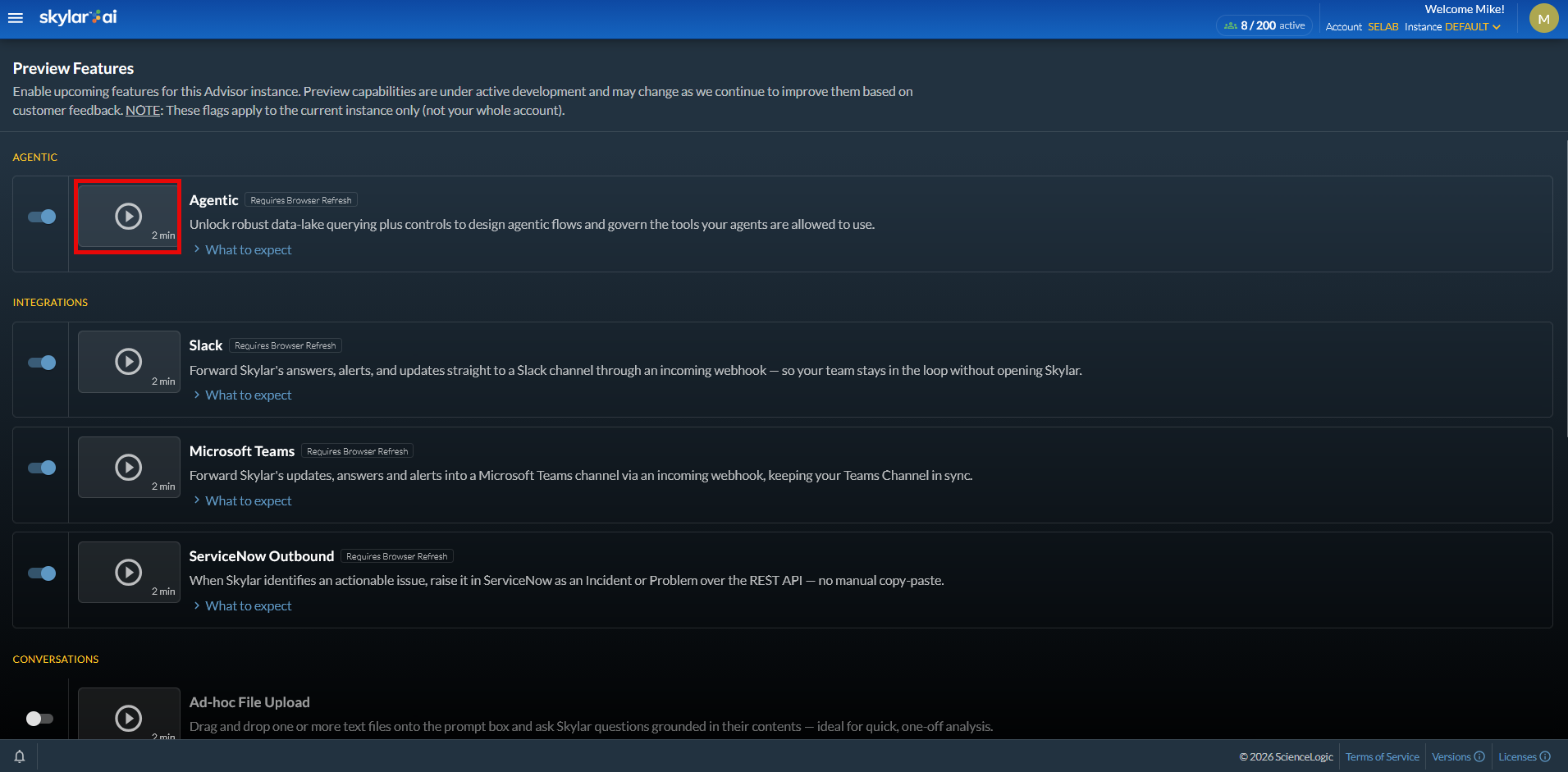
Each preview feature contains a What to expect section that you can click to get more information about that feature and where to use it in the Skylar Advisor user interface.
The left pane of the Preview Features page includes clickable views on the left that organizes the preview features by category, such as Agentic, Integrations, Work Items, and Platform. The views also list the number of features for each set of features.
Click the "Play" icon next to a preview feature to watch a short demo of that feature. Also, some features might require you to refresh your browser before they appear.
Feature "Graduates"
The Preview Features page also includes a clickable view for Graduates, features that used to be listed on the Preview Features page, but are now officially part of the Skylar Advisor user interface. The "graduates" are listed by release.
For Skylar AI 2.7.0, the following preview features were made permanent:
- MCP Tools, which are now covered in MCP Services.
- Scheduled Reports, which are now covered in Scheduling Reports for Skylar Advisor.
- Ad-hoc File Upload, which is now covered in step 2 of Using the Ask Skylar Feature.
- Trend Analysis, which is now covered in Trend Analysis.
- Conversation Audit, which is now covered in Additional Options on the Ask Skylar Page
For Skylar AI 2.6.0, the following preview features were made permannt:
-
Slack Integration and Microsoft Teams Integration, which are now covered in Sharing Information with Slack and Microsoft Teams Integrations.
-
Active Session Tracker, which is now covered in Managing Active Sessions.
Agentic
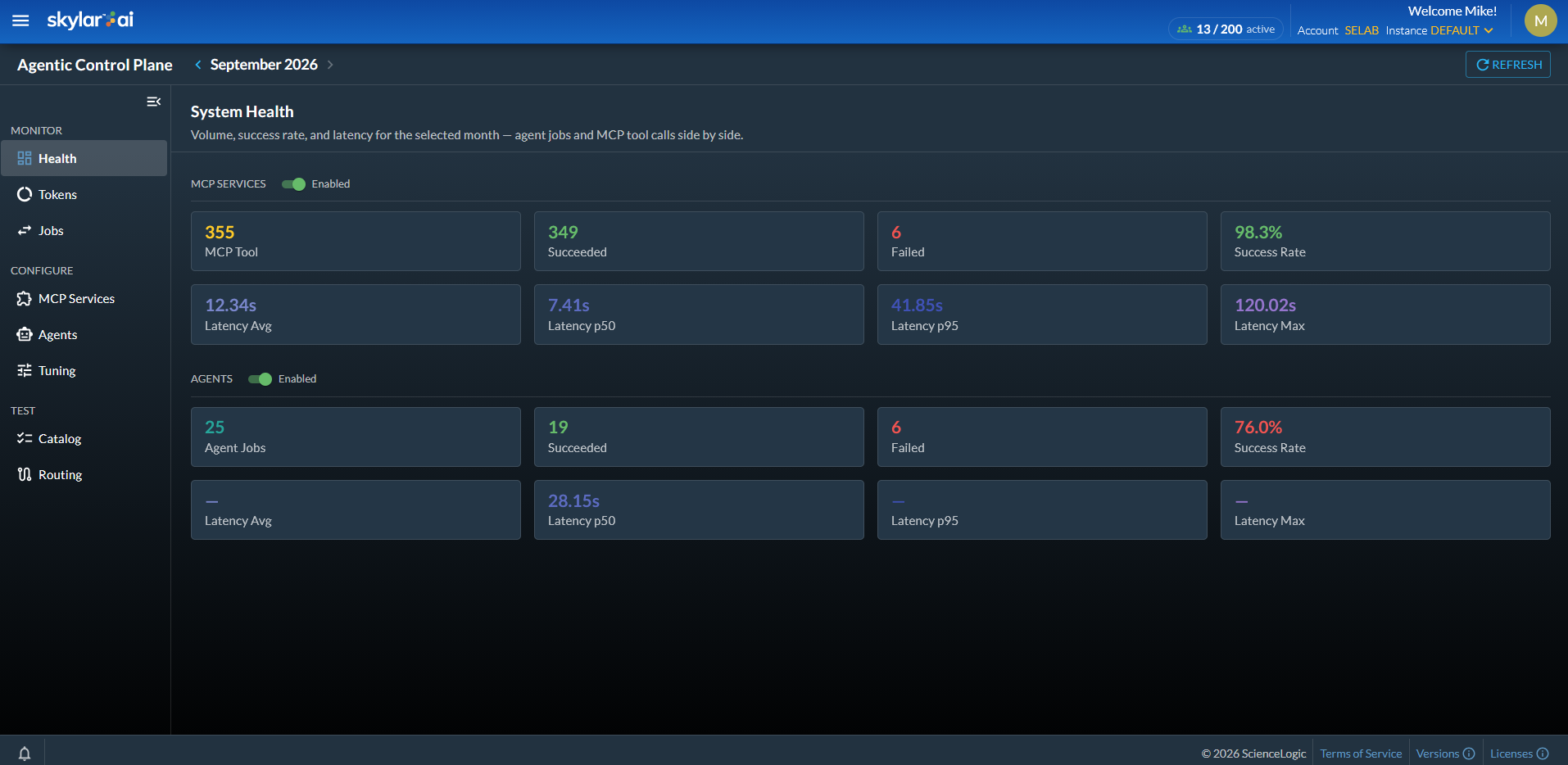
Selecting the Agentic option on the Preview Features page enables the Agentic Control Plane page ( > Account Settings > Agentic Control Plane). This page lets you monitor any AI agents that you are using with Skylar Advisor. You can view a list of agents, jobs, tools, and health, along with latency information, audit trails, agent limits and bounds, and token spend over time.
When you enable an agentic tool, Skylar Advisor routes the relevant questions to that tool instead of searching the documents on the Corpus page. Each agentic tool comes pre-loaded with a list of sample questions.
For more information, see Using the Agentic Control Plane Page.
Integrations: ServiceNow Outbound
In the Integrations view, you can enable ServiceNow Outbound to enable Skylar AI to automatically create a ServiceNow Incident or Problem from a Skylar AI result, accelerating incident response and reducing manual operational handoffs. This feature is still under development.
Integrations: Web Search
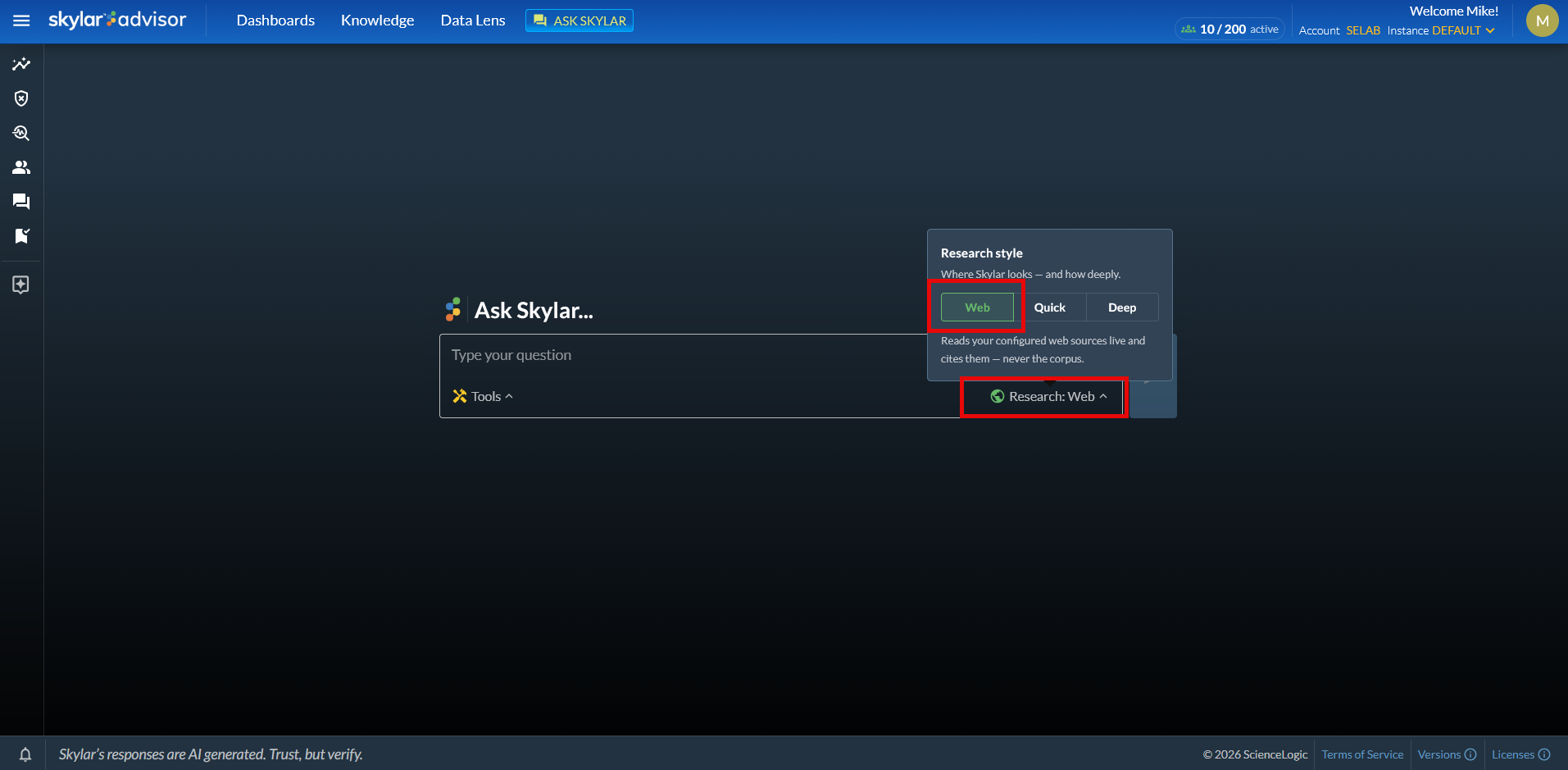
In the Integrations view, you can enable Web Search to let you perform an on-demand web search of specific websites and web sources instead of using the documents in the Corpus. Answers include source links and retrieval times, and they are never stored nor indexed. You can set up the web sources on the Web Search view on the Knowledge Center page.
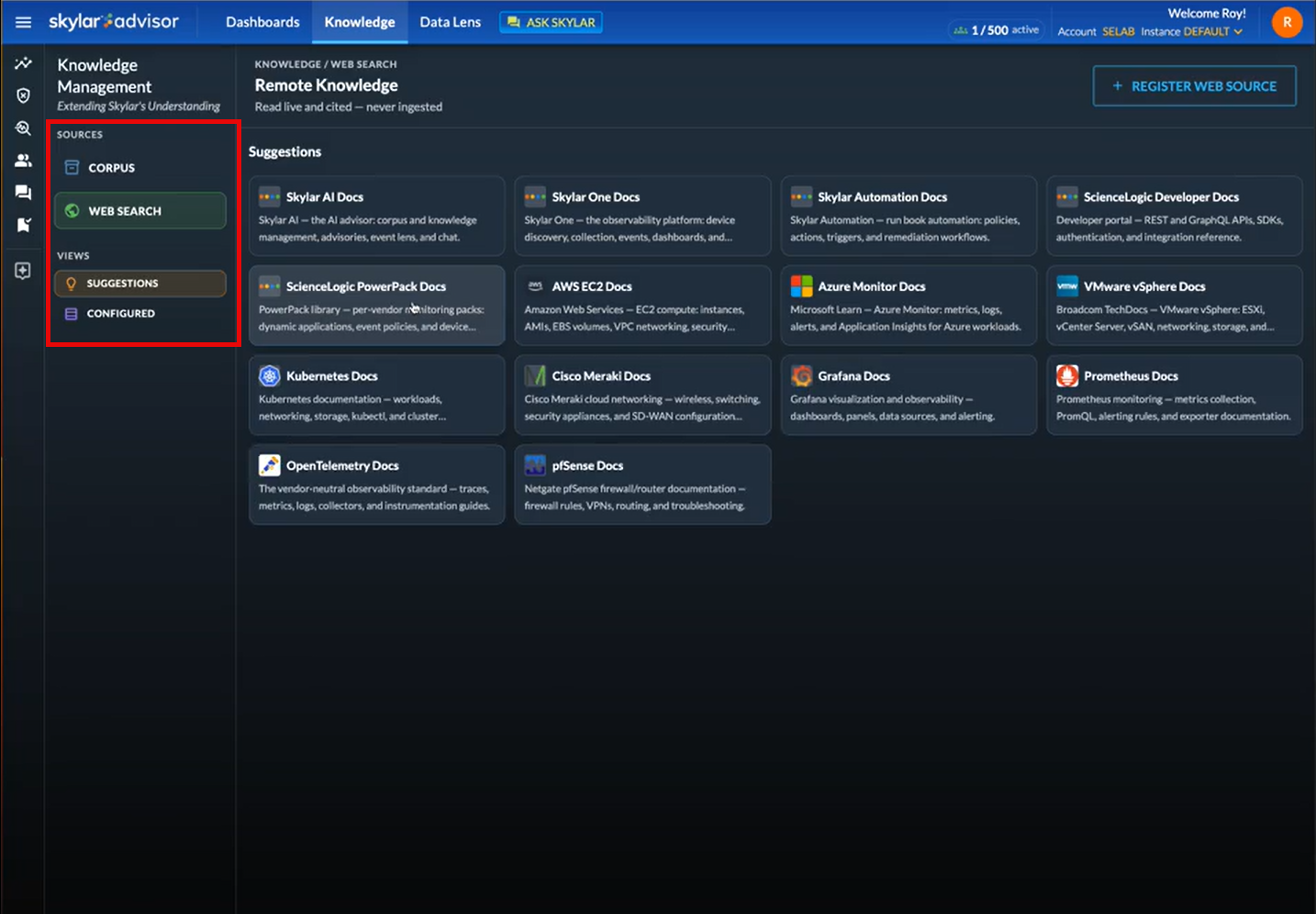
On the > view, you can configure a suggested web source, such as Windows Server Docs, to point Skylar Advisor at that source for answers. You can configure five different ScienceLogic Product Documentation sites as well as third-party sites.
The > view shows the web sources that have been configured for web searches.
You will need to click Research: Web in the Ask Skylar prompt box to use this feature:
Work Items: Claim and Close
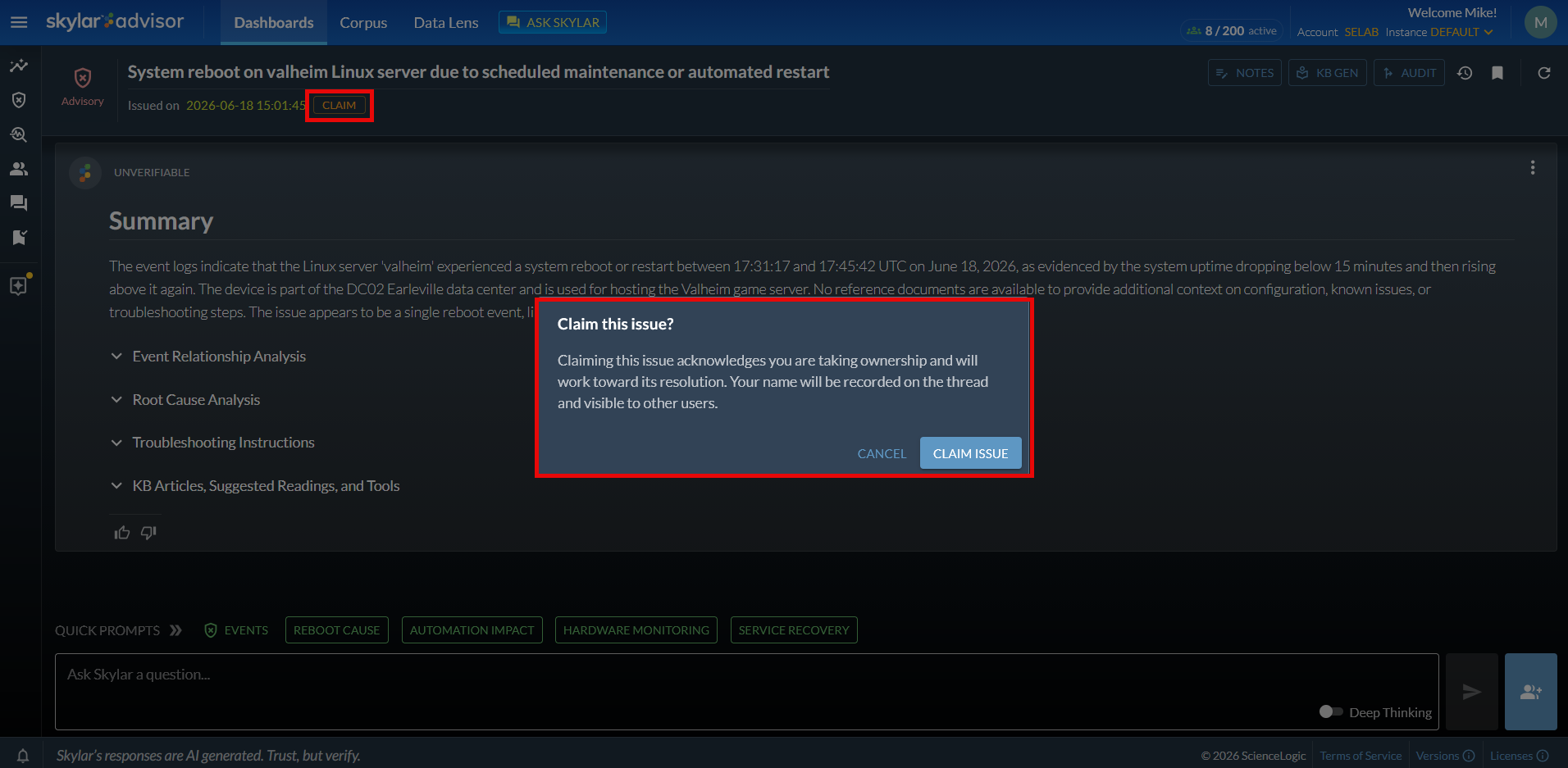
In the Work Items view, you can enable the Claim & Close option to add the ability to claim an Advisory or an Investigation, which means you assign it to yourself. Your name will then appear on the activity next to "Claimed by". You can also close an Advisory or an Investigation when you have addressed it. If needed, you can re-open a closed activity.
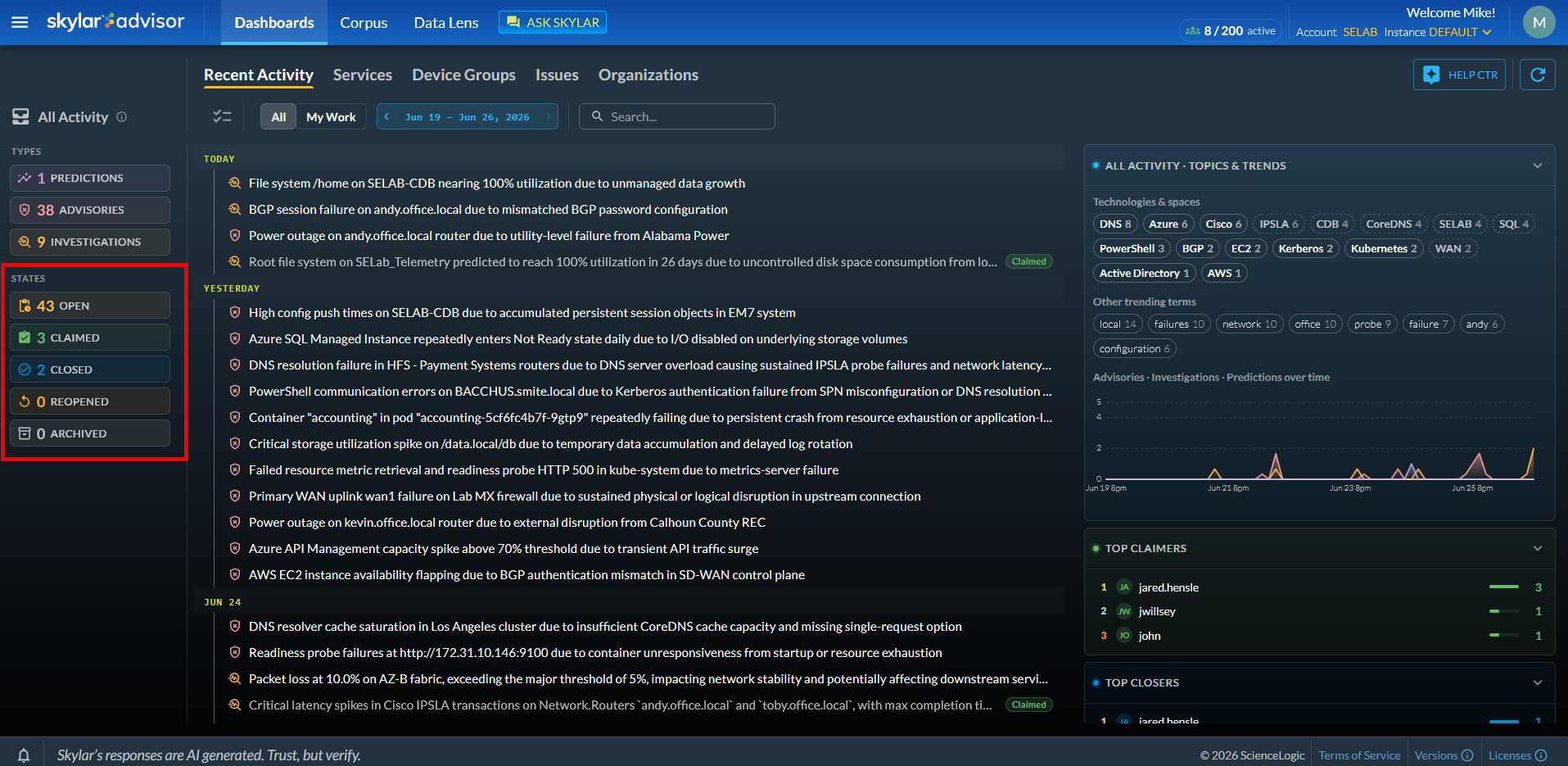
This option also adds additional, clickable filters to the Dashboards page: Open, Claimed, Closed, Reopened, and Archived. These filters create an audit trail for your activity, so you can see who changed what for that activity. You can see all of the activities that you have claimed on the My Work filter.
Work Items: Metrics Enhanced Advisories
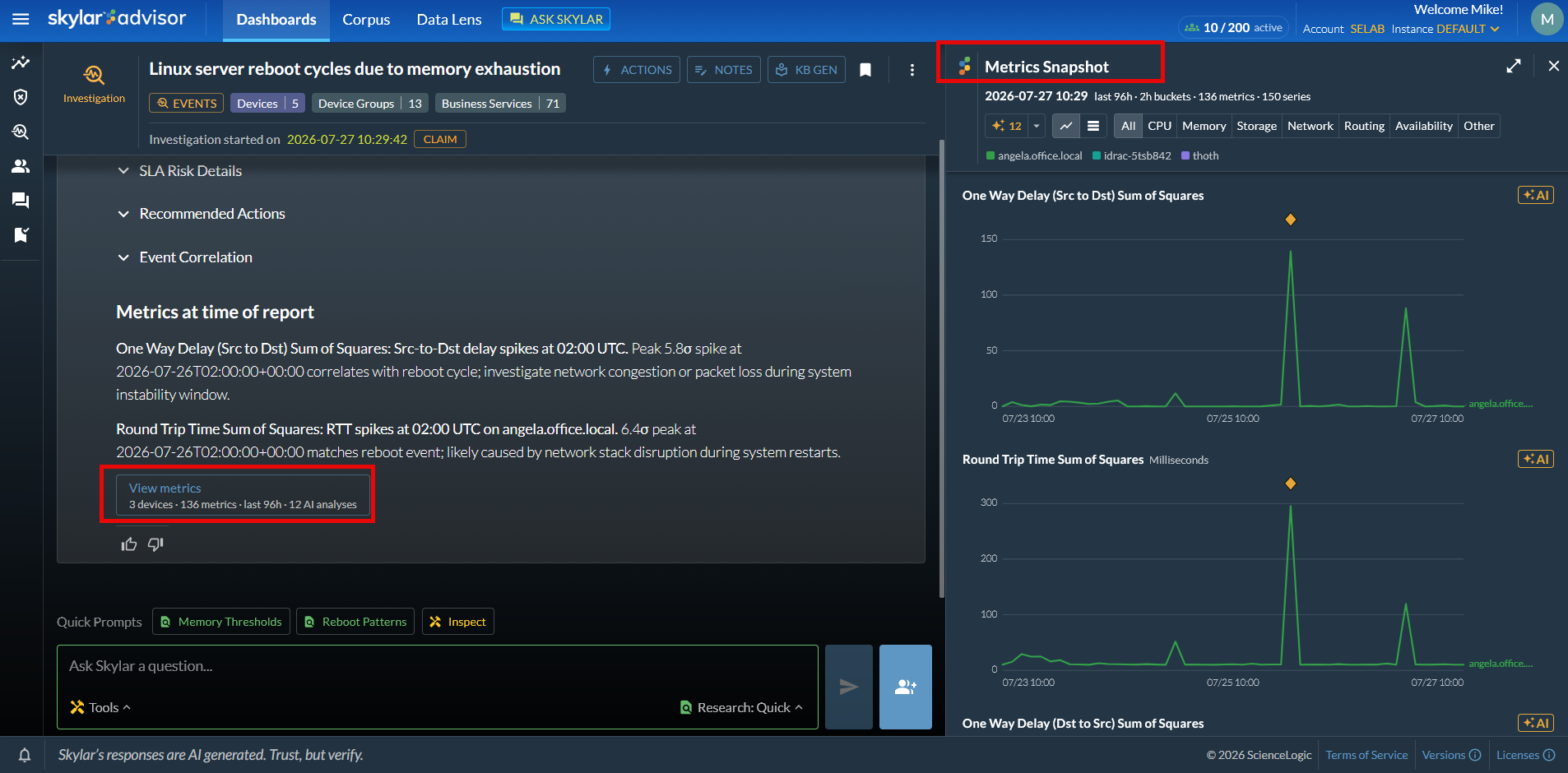
In the Work Items view, you can enable Metrics Enhanced Advisories to add more data to an Advisory or Investigation. When an Advisory or Investigation is generated, Skylar Advisor snapshots the data-lake metrics for the affected devices and adds an AI-analyzed summary to the report. When you click the button, the data displays as a chart on the Metrics Snapshot pane.
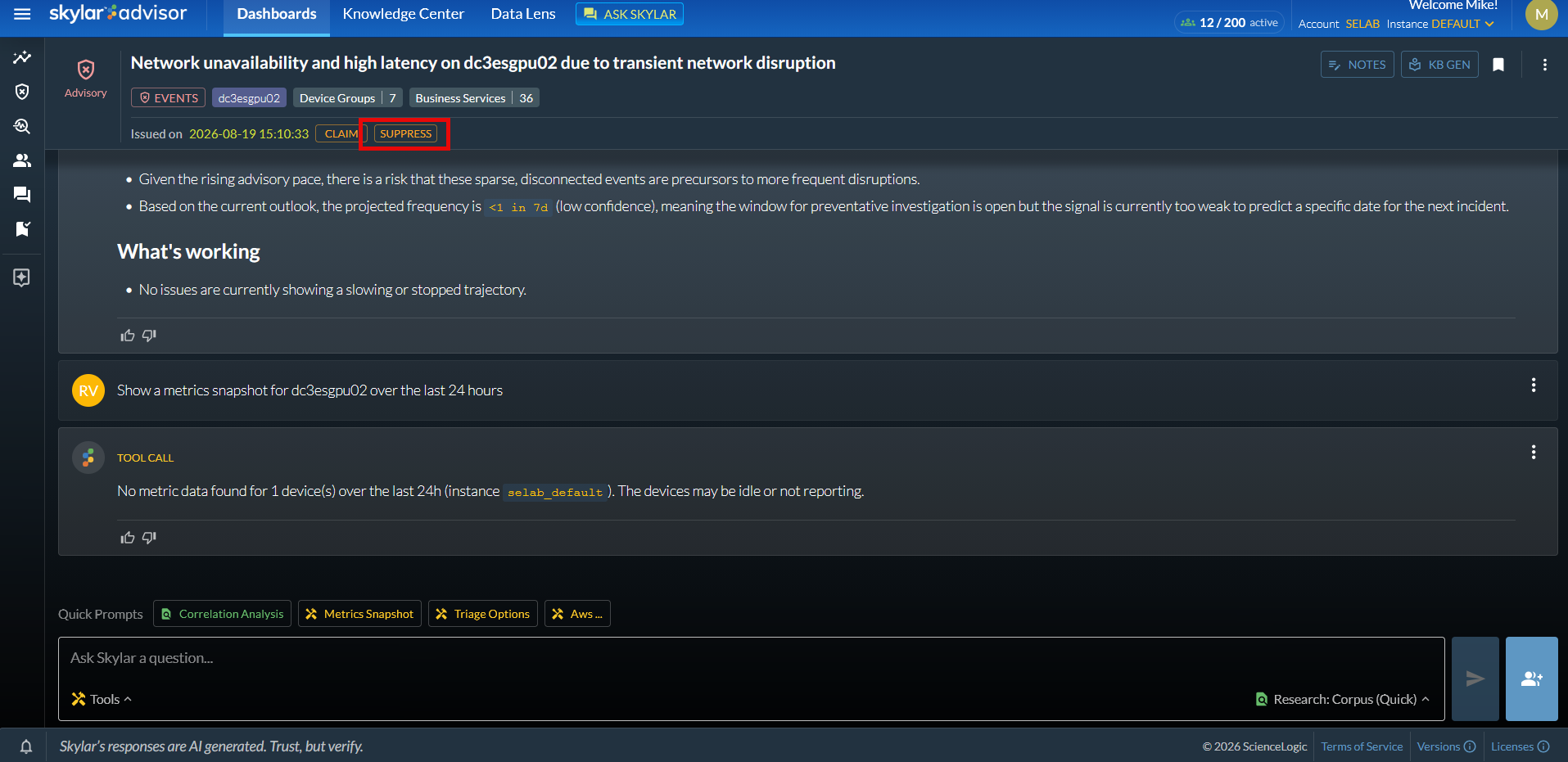
Work Items: Advisory Suppression
Advisories now includes a button that lets you suppress an Advisory, preventing Skylar Advisor from reporting on that kind of Advisory again.
Work Items: Data Lens Events
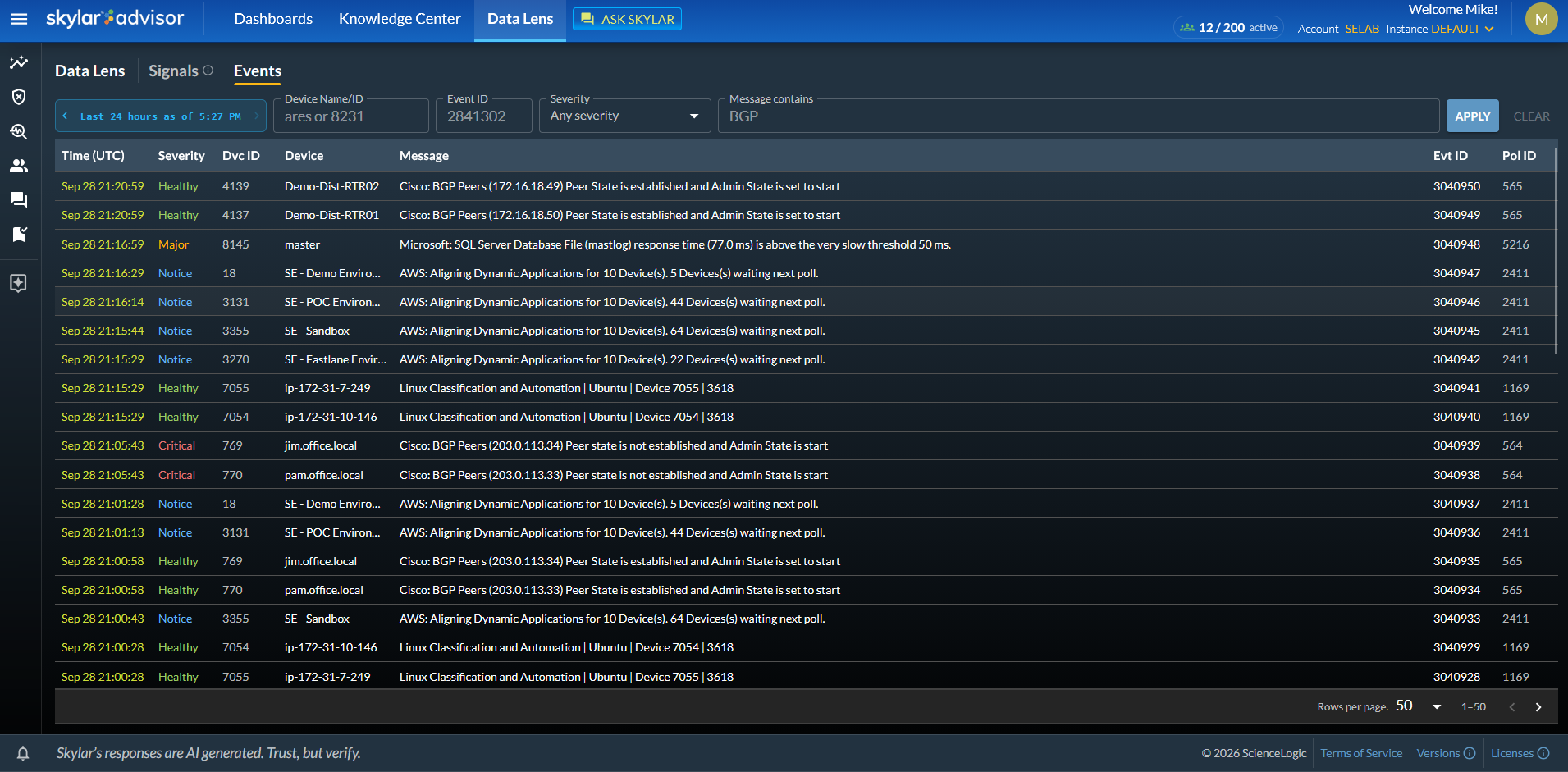
Enabling this option adds an tab to the Data Lens page that displays a table of events. This feature provides you with better visibility into the specific events being received and considered for signal generation.
Platform: Corpus Tools
Enabling this option adds an view to the tab on the Knowledge Center page for situations where the documentation in the Corpus is insufficient or earned a down vote ( ). Skylar Advisor presents tools to cover the gaps, or you can generate a new document that addresses the issue.

Platform: KB Generated Approval Flow
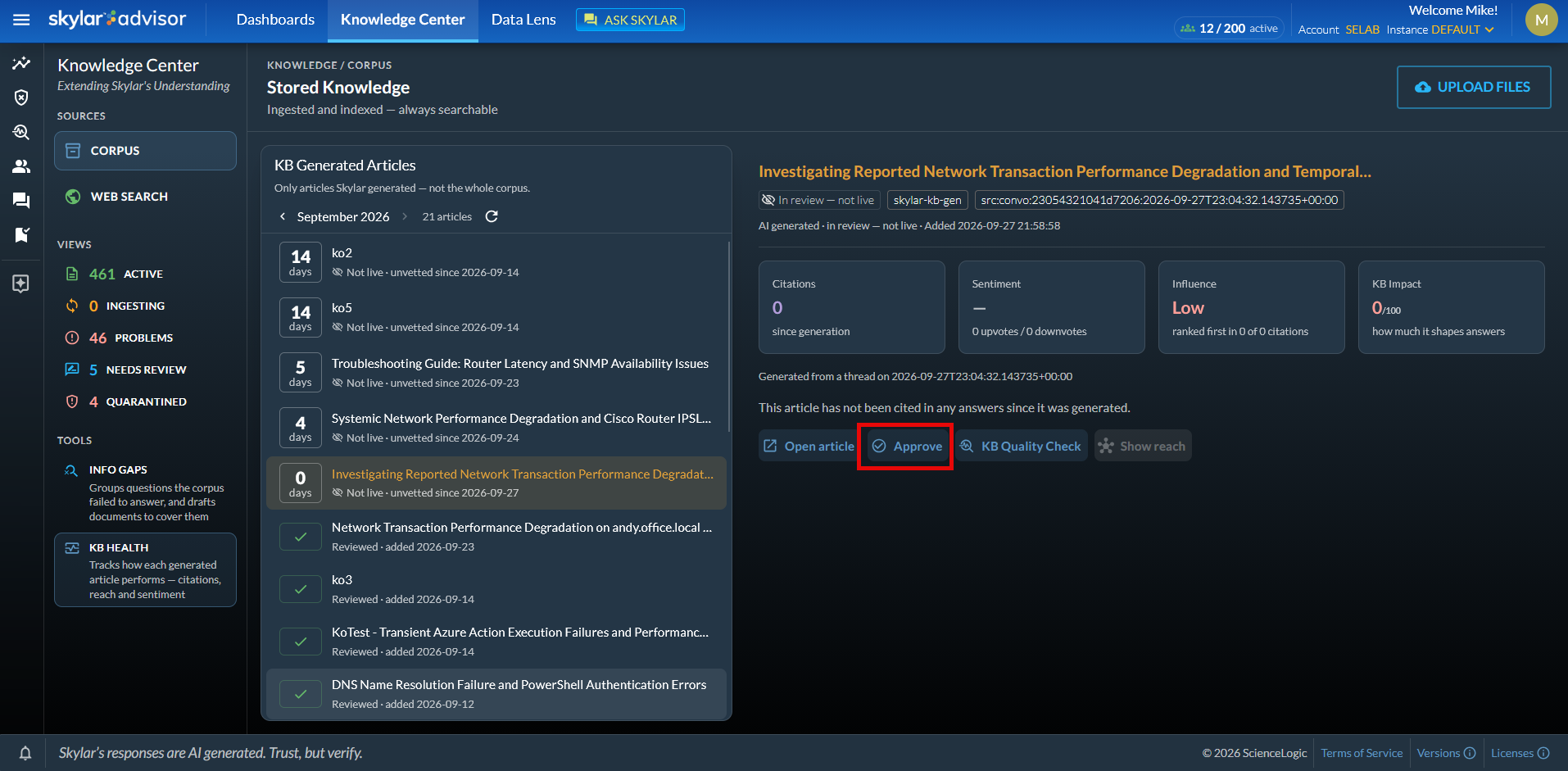
Enabling the KB Generated Approval Flow option on the view of the Preview Features page enables a review workflow for Knowledge Base articles generated within the Corpus. This feature lets Subject Matter Experts (SMEs) approve or reject articles instead of immediately publishing the article. This gives reviewers a chance to read and approve the article first.
You can use the view to the tab on the Knowledge Center page to track citations, sentiment, influence, and impact for each generated article, with an AI quality check and a proposed rewrite. You can also click to add a KB article to the Corpus.
Platform: Knowledge Sentry
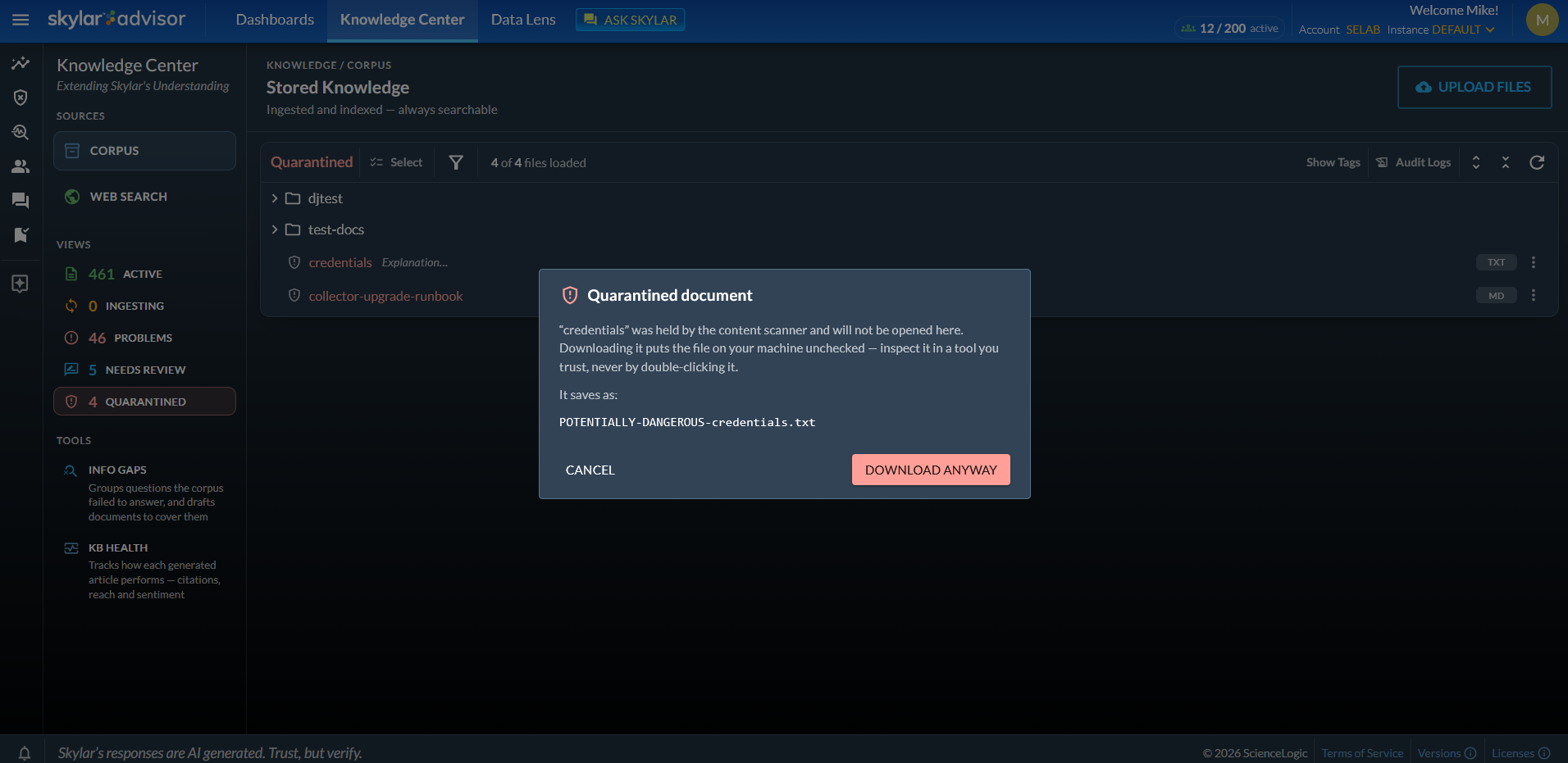
Enabling the Knowledge Sentry option on the view of the Preview Features page implements a security gatekeeper layer for document uploads to the Corpus. Files are now automatically scanned for secrets, SQL injection patterns, and adversarial hidden text. Any suspicious files are quarantined until a subject-matter expert reviews them.